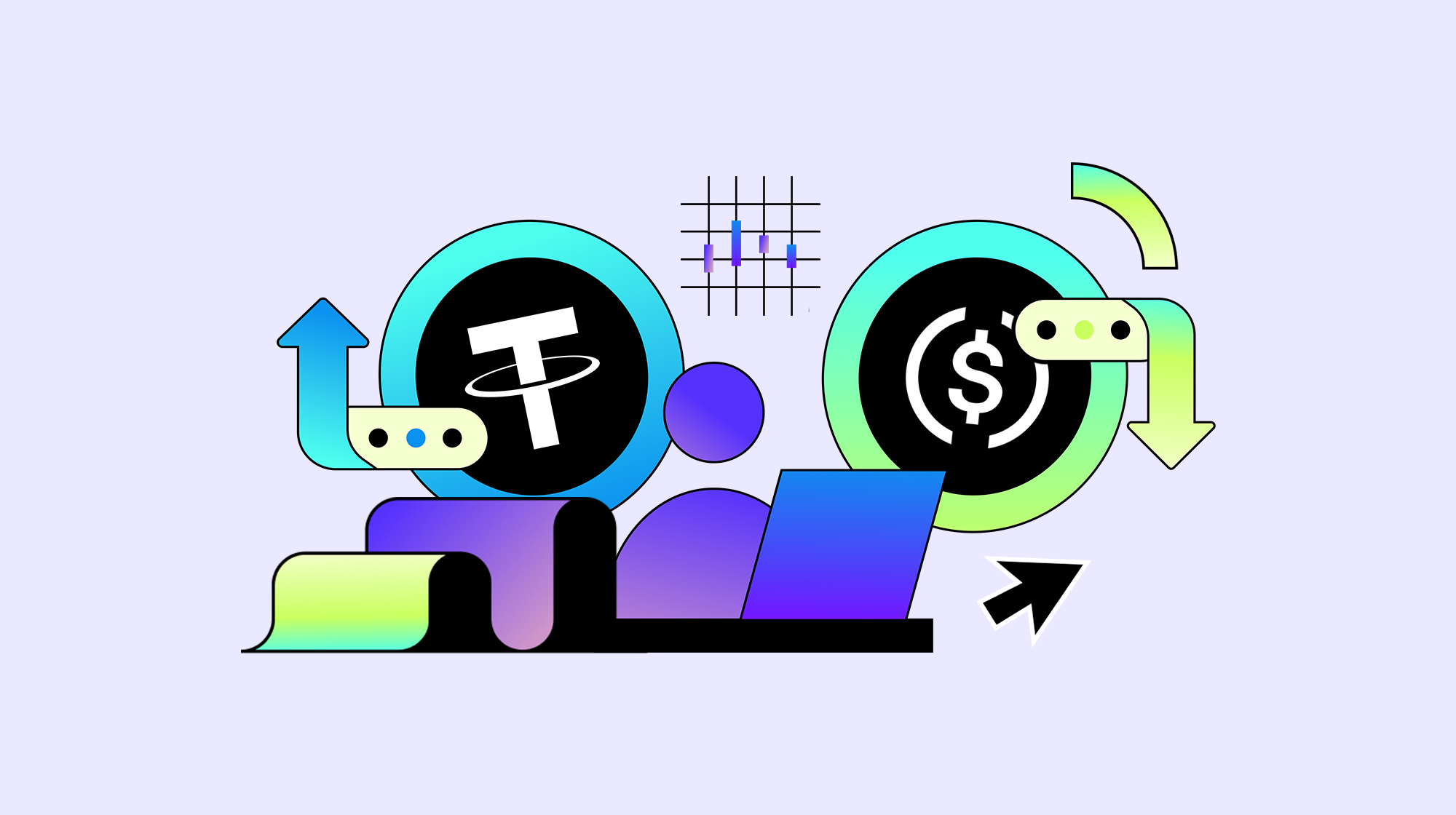
By early 2026, the total market capitalization of the stablecoin market has surpassed the hundreds of billions of dollars mark, becoming the most widely used and commercially successful sector in blockchain technology. Within this space, the two giants—USDT (Tether) and
USDC (USD Coin)—have long maintained a dominant position. While they appear identical in function—both pegged to a value of $1 and providing stability through 1:1 asset collateralization—their underlying issuance philosophies, risk governance, compliance frameworks, and ecological positioning are worlds apart.
CoinW Academy will take a deep dive into the fundamental differences between these two major stablecoins to help you make more rational asset allocation choices based on your trading needs and risk tolerance.
Origins and Positioning: The Market Pioneer vs. The Rule Shaper
To understand the differences between USDT and USDC, one must first trace their genetic origins.
USDT: The "Native Currency" of the Crypto World Tether Limited launched USDT in 2014, making it the first fiat-collateralized stablecoin to achieve massive commercial success. In the early days of cryptocurrency development, it was extremely difficult for exchanges to access direct banking services (making "fiat off-ramping" very hard). The emergence of USDT provided traders with a tool that could circulate between different exchanges and serve as a hedge without needing to exit into the banking system. This "first-mover advantage" has deeply embedded USDT into the infrastructure of cryptocurrency, making it the settlement benchmark for almost all centralized exchanges (CEXs).
USDC: The "Trust Benchmark" of the Compliance Era In contrast, the birth of USDC (2018) carried a strong "standardization" color. It was issued by the Centre Consortium, co-founded by Circle and Coinbase. From its inception, USDC aimed to be the "transparency template" among stablecoins. Its goal was not to fill an early liquidity void, but to introduce the trust standards of Traditional Finance (TradFi) into Decentralized Finance (DeFi). By embracing regulation, undergoing regular rigorous audits, and partnering with financial giants like BlackRock, it quickly won the favor of institutional investors.
Reserve Assets and Transparency: Black Box vs. Glass Box
For any fiat-pegged stablecoin, the core question is simple: Does it truly have 100% underlying backing?
USDT: From Controversy to Proof of Resilience The composition of USDT's reserves has historically faced numerous questions. Early on, the market feared its reserves contained a large amount of high-risk commercial paper. However, with increasing regulatory pressure and shifts in corporate strategy, Tether has significantly adjusted its balance sheet as of 2026. Today, USDT is primarily backed by U.S. Treasuries, cash, repurchase agreements, and small amounts of precious metals and
Bitcoin. Although Tether has yet to provide full financial reports audited according to standard accounting principles—relying instead on periodic "attestation reports" to disclose reserves—its strong redemption resilience during several market crashes (such as the Terra collapse in 2022 and market volatility in 2024) has solidified its position as the global king of liquidity.
USDC: The Pursuit of Absolute Transparency The reserve structure of USDC is recognized as the industry gold standard. Its reserves consist almost entirely of cash and short-term U.S. Treasuries, primarily held in strictly regulated U.S. financial institutions (such as BNY Mellon). More importantly, the Circle Reserve Fund is managed by BlackRock, which means the safety of the assets is endorsed by a top-tier financial institution and the flow of USDC reserves is fully traceable and verifiable. For companies or hedge funds that need to prove asset safety to auditors, USDC is the most straightforward digital asset on their financial statements.
Regulatory Compliance and Geopolitical Games: Safe Haven vs. Regulated Zone
In 2026, with the passage of the U.S. GENIUS Act and the full implementation of the EU’s Markets in Crypto-Assets (MiCA) regulation, the survival environment for stablecoins has undergone a dramatic shift.
USDC: Global Expansion Under the Regulatory Dividend USDC has always proactively sought regulation. It was among the first dollar-pegged stablecoins to be fully compliant with MiCA regulations for issuance within the European Union. This means that on regulated European exchanges, USDC is often the preferred or even the only compliant settlement option. For investors living in regions with tightening compliance, holding USDC means a lower risk of passive seizure or freezing, as Circle’s issuing entity operates entirely within legal frameworks.
USDT: Vitality Beyond the Mainstream Tether’s stance is more aggressive and "offshore." While it cooperates with global Anti-Money Laundering (AML) requirements, it is typically registered in jurisdictions with relatively relaxed oversight. This strategy gives it greater flexibility than USDC when facing certain extreme geopolitical changes, particularly in Asia, Latin America, and the Middle East. However, risks follow: because USDT finds it harder to meet the stringent licensing requirements of some regions (such as certain EU regulations for specific e-money tokens), it may face delisting risks in some mainstream compliant channels. This "non-adversarial cooperation" model has made USDT a sanctuary for users who do not wish to be overly exposed to the jurisdiction of a single nation.
Technical Ecosystem and Liquidity: TRON’s Efficiency vs. Ethereum’s Breadth
Even for a 1:1 U.S. dollar, performance varies significantly across different blockchain networks (L1/L2).
USDT: The "Behemoth" of Liquidity If you are conducting high-frequency trading on centralized exchanges, USDT is irreplaceable. It possesses the deepest order books and highest trading volumes globally. Particularly on the TRON network, USDT’s circulation is extremely high; not only are transfer speeds fast and fees extremely low, but it has also become the "de facto standard" for global cross-border payments and P2P transactions. For most average users, USDT’s multi-chain coverage is so broad that liquidity pairs for USDT can be easily found on nearly any public chain.
USDC: Protocol-Level Integration in DeFi and Cross-Chain USDC is more dominant within the Ethereum ecosystem and DeFi protocols on major L2s (such as Arbitrum, Optimism, and Base). Due to its compliance, most decentralized lending protocols (such as Aave and Compound) utilize USDC as a primary collateral asset. Furthermore, the Cross-Chain Transfer Protocol (CCTP) introduced by Circle has completely changed the game for asset migration: users can "burn and mint" native USDC across different chains without relying on the risks associated with centralized bridges. This technical nativeness is making USDC the preferred "programmable money" for blockchain-native applications.
Lessons from Historical Crises: When De-pegging Occurs
No asset is absolutely safe. Looking back at the volatility of recent years allows for a more objective evaluation of the risk margins for both.
USDC’s 2023 Moment of Terror The collapse of Silicon Valley Bank (SVB) in March 2023 caused a rare de-pegging of USDC (briefly dropping to near $0.88). This occurred because Circle held a portion of its cash reserves at that bank. While USDC quickly returned to $1 due to Federal Reserve intervention and Circle’s transparent operations, it served as a warning to the market: even the most compliant stablecoins cannot escape the structural risks of the traditional banking system.
USDT’s "FUD" Resistance Test Over the years, USDT has faced countless short attacks and regulatory threats. While its price has seen slight deviations during moments of extreme volatility, its powerful OTC channels and Tether’s accumulated profits (billions of dollars annually) have given it a strong buffer for redemptions. Tether’s profits are now even sufficient to cover small potential losses within its reserves, providing a form of "informal insurance" at the psychological level for users.
Investor Decision-Making: How Should You Choose?
In the context of 2026, choosing a stablecoin should no longer be based on blind preference, but on your actual use case:
-
If you are an active short-term trader: USDT is the best choice. Its extremely high liquidity ensures you can complete stop-losses or arbitrage with minimal slippage during major market shocks, and broad support for low-fee networks like TRC-20 saves significant interaction costs.
-
If you are an asset manager seeking long-term allocation: USDC provides higher certainty. Its underlying assets are held by top-tier institutions and are subject to continuous oversight by multiple national regulatory systems, making it more suitable for storing large amounts of idle funds not intended for frequent operation.
-
If you are deeply involved in DeFi farming or lending: USDC, in most cases, provides more stable borrowing rates and higher collateral ratios. Simultaneously, the CCTP protocol allows you to switch seamlessly between different public chains to capture yields.
-
If you are in a cross-border settlement or P2P environment: USDT has stronger social consensus, especially in regions where the banking system is underdeveloped; USDT is almost synonymous with the U.S. dollar.
Conclusion: Coexistence Rather Than Replacement
The competition between USDT and USDC is not a "winner-takes-all" elimination race, but a bidirectional evolution as the crypto market moves toward maturity. USDT carries the purest ambitions of cryptocurrency: liquidity, freedom, and global barrier-free circulation; while USDC represents the deep integration of blockchain technology with the real world: transparent, trustworthy, and within legal frameworks.
As an investor, the wisest approach is often not to take sides between the two, but to allocate reasonably based on the principle of risk diversification. The future of the stablecoin market will belong to those issuers who can provide both lightning-fast settlement and allow users to sleep soundly at night. Whichever side you lean toward, understanding the logic behind their operations is your first step toward steady navigation in the ocean of digital assets.
From raw information to professional expertise. Partner with top researchers at CoinW Academy and build your systematic crypto knowledge today.